Pages

Thursday, November 13, 2008

Sceptical Activism and the Prime Directive

In a recent episode of the Geologic Podcast, George was asked a question about how he felt about sceptical activism in contrast to respect for cultural diversity. He immediately equated it to the Prime Directive, and discussed his initial thoughts on it.

This is a thought that has occurred to me as well. I was recently asked to participate in a panel discussion at an SFSA convention on the Prime Directive, so its intricacies are still relatively fresh in my mind.

The Prime Directive is a fictional law in Star Trek that prohibits Starfleet personnel from interfering in any way with members of other cultures. The assumption is that any interference, even if benevolent in intent, could have unforeseeable consequences that could potentially be disastrous.

The motivation for it stems from one of the underlying philosophical tenets that Starfleet adheres to: IDIC - Infinite Diversity in Infinite Combinations. Federation citizens are not permitted to assume that just because their technology is more advanced than other cultures, that they are superior to them in an way. And therefore may not impose their own values upon other cultures, but must rather allow them to develop on their own, in the hope that someday they might greet them as technological equals, and possibly as allies.

While this law makes sense in the context of a world where interstellar travel is easy, and where primitive cultures can exist in effective isolation until they are able to master Warp Drive, how applicable is it to 21st century Earth? And particularly to those of us who wish to advocate and propagate what we think is a superior technology: critical thinking?

In short: do I have the right to try and help a true believer by exposing them to critical thinking? If the believer asks for help, that would be one thing. But that almost never happens... in the vast majority of cases, the believer is happy in their delusions, and doesn't want my "help".

James Randi makes an analogy that sceptical activism is like running into a burning building and carrying some poor resident out over your shoulder. That certainly seems like the right thing to do. But what if that resident doesn't want to be saved? What if they like it in there, and are blindly willing to accept the consequences of remaining inside?

It seems silly that that might be the case, but it does appear to be. True believers seem content to sit comfortably in the blazing inferno, blissfully unaware of the danger they're in. And unwilling to listen to anyone tell them otherwise.

Conversely, a Christian might see my atheism as similarly sitting in the fire of eternal damnation. They're probably wrong, but they don't know that.

I see blogging as something of a compromise. I put content into the ether, and people can find it if they're looking. It's a pretty milquetoast medium though, because it's so passive. I would much rather have a soap-box in the mainstream media - television or radio, where I could actively get my message to a far larger audience. But do I have a right to do that?

Yes, I know that the woo faction don't hesitate to use the media to propagate their nonsense... and to substantial effect. Just as in Star Trek, races that don't adhere to the Prime Directive see no harm in exlploiting technologically less advanced people wherever they find them. But that doesn't make it right. Fighting fire with fire isn't necessarily the ethical choice.

So I find myself in something of a quandry. What do you think?

Wednesday, November 12, 2008

Back to Basics: Evolution

I was inspired by a recent debate I participated in to present here a brief outline of the evidence that exists for evolution. I'm not the first to do this, and this is far from an exhaustive resource, but hopefully I'll be able to provide a good starting point for any evolution deniers who are genuinely interested in learning more about it.

Where did the idea of evolution come from?

It's a common misconception that the theory of evolution was developed, in whole cloth, by Charles Darwin and remains dogmatically unchanged to this day. This is not the case.

The idea of biological evolution seems to date back to the philosophers of ancient Greece, who noticed anatomical similarities between different life forms, and postulated that those life forms might share some sort of common ancestor.

This idea fluctuated in its popularity, but remained pretty firmly in the realm of philosophy until Charles Darwin provided a plausible mechanism through which evolution might work: natural selection. Only then did evolution transform from an idea to a theory - it could make predictions that could be tested.

And tested it was. Since Darwin's first publication, On the Origin of Species, much has been learned about biology, and all of it, so far, has fit neatly into the Theory of Evolution. Sure, a lot of the details had to be rethought, but no evidence produced so far has refuted the theory as a whole.

Okay, so what's the evidence?

As with most theories, there is no one piece of evidence that can prove or disprove evolution. That's not how science works. Rather there are multiple lines of evidence that all converge at a point, and that point is very successfully explained by the theory of evolution.

The first evidence, that which gave rise to the idea to begin with, is that of anatomical similarities between species. This is something we can see with our own eyes.

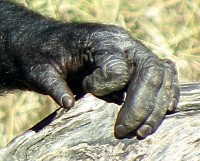
Look at your hand. It's attached to the end of a limb. One of four similar limbs. It probably has five digits - four fingers and an opposable thumb. 

Now look at a chimpanzee's hand. It's very similar, isn't it? It's also at the end of one of four limbs, and also consists of five digits - four fingers and an opposable thumb. A chimp's hand is a little different though. It's hairier, and the comparative lengths of the digits is a little different. 

Now look at a monkey's hand. Again, very similar, but not quite as similar. Now look at a lemur's hand. And a rat's. And a lizard's. And a frog's.

If you line up all these images you can almost see a steady progression from frog hand to human hand. It almost looks as if frogs possess the primeordeal hand, and that lizards, rats, lemurs, monkeys, chimps and humans all descended from the frog, collecting upgrades to their hands as they went.


This isn't how it happened, but it's not far off. What it does suggest is that chimps and humans had a common ancestor... one that probably looked more like a chimp than a human. And that that common ancestor probably had another common ancestor shared with modern monkeys - one that probably looked more like a monkey than a chimp, and so on all the way back to frogs.

Okay, so now we have the makings of a hypothesis. In order to test it, we need more evidence.

What else do we now know about living things? They have DNA which is passed down from one generation to another. We know that DNA is largely responsible for determining what we look like, how we act and what we do. So if chimps and humans have a recent common ancestor, we can predict that they would probably have very similar DNA. Right?

Well, that has been tested. And guess what? Humans and chimps have very similar DNA! Not only that, humans have DNA that is similar to monkeys, but not as similar as to chimps. And even less similar to lemurs. And so on, all the way down to frogs.

Okay, so we now have one line of evidence that points to evolution being true. Of course there are other possible explanations for the DNA similarity. And that's okay. What we need to do is look for other predictions that evolution makes, and test those.

If humans and chimps had a common ancestor, it would probably have been very long ago. Millions of years. We know this because we know the average mutation rate of human DNA, and therefore we can come up with a pretty good estimate of how long it would take something like a chimp to evolve into something like a human, one mutation at a time.

So how do we find out whether animals existed in the distant past? Unfortunately there's no good way of doing that. But there is one way: fossils.

Sometimes an animal dies in just the right spot at just the right time and impresions of its body are preserved in rock. This is very rare, and we're lucky to have any fossils at all. But we do have a few... just enough to see that animals once existed that were something like a chimp, and also something like a human.

We can also tell, by using various techniques, how old the rocks are that the fossils are preserved in. This gives us a rough date of when that animal lived. If that date is close to the date predicted by evolution, we have another confirmatory line of evidence on our hands. And guess what! It matches!

Again, it's still possible that it's just a coincidence that humans and chimps share DNA and that an animal once existed that looks like it may have been a common ancestor of both. There are still other hypotheses that could explain both of these. So how do we go about determining the better theory?

One way is by applying the same test to other species. If we see the same pattern of DNA similarity and fossil record apply to lots of other species, it lends considerable weight to the evidence. This, also, has been done. And guess what? It confirms it!

So what do we have? We have a theory that makes some pretty clear predictions. Those predictions have been tested, and the theory has been upheld. So it's plausible. But is evolution actually possible? Can we see organisms developing new traits as a result of random mutations coupled with natural selection? Yup.

Is that it? Three lines of evidence?

Well, yes and no. What I've given here is a very broad oversimplification of the lines of evidence supporting the theory of evolution. Each of these lines of evidence actually consists of hundreds, if not thousands, of individual strands of evidence. The depth of this subject, and its many, many forms of evidence, is enough to keep some of the brightest people busy all the time. I encourage you to explore them, as I have been doing.

One strand on it's own is weak, and can't withstand much scrutiny. But the combined strength of all those individual strands, all aligned in the same direction, makes the Theory of Evolution one of the most reliable ideas known to science. Evolution isn't just a fact, it's an orchestra of facts, playing in harmony the music of life as we know it. 

Evolution is us.

Monday, November 03, 2008

Stop Sylvia Browne

Due to a series of unfortunate events, Skeptical Superhero Robert Lancaster has had his old domain commandeered by psychic pirates.

If you're looking for Robert's Stop Sylvia Brown goodness, you'll need to point your browser to stopsylvia.com.

If you want to find out what you can do to help, check out this article over at Skeptools.

Dauntless Crew Show Me the Love

I thought some of you may enjoy some of the art produced by one of my Officers, Ensign Jim Nave, in an attempt to educate and protect his crewmates.

Monday, October 13, 2008

Open Letter to Danie Krugel

Hopefully this letter will receive a better response from Mr Krugel than mine did.

(In case you're wondering, he never did respond to mine)

Thursday, October 09, 2008

Stop Danie Krugel

As my regular readers will no doubt be aware, I have blogged about Danie Krugel several times.

For the new kids, Krugel is a guy who obtained notoriety for his supposed invention of a machine that can track people over long distances using DNA, quantum mechanics and GPS technology.

In other words, it doesn't track anybody.

But that hasn't stopped him from preying on vulnerable and desperate people looking for their missing loved ones, and generating a fair amount of media buzz.

Fortunately Ivan from Subtle Shift in Emphasis has launched a campaign to expose this fraud for what he is. Go check it out: www.stopdaniekrugel.com

Wednesday, October 08, 2008

New Blog

I've started a new blog that probably won't interest many of you. But I thought I'd announce it here anyway, in case some of you are desperate for something to read.

STARFLEET International are going through a tough time at the moment. The Commander STARFLEET is pretty unpopular with a small group of outspoken dissidents, and has faced an unending torrent of what can only be described as abuse from them since he entered office in January.

As a result of the unending flame war, hundreds of members are choosing not to renew their membership, and STARFLEET is in pretty bad shape. Several of the dissidents have created blogs as a soap-box for their rhetoric, and I thought it was time for someone to inject a little logic into the proceedings.

So I launched STARFLEET Fail FAIL, a play on the name of the biggest of the dissident blogs, STARFLEET Fail. My fellow bloggers and I intend to try and critically analyise the arguments presented by the dissidents with the intent to weed out all the logical fallacies, propaganda techniques and pure silliness in the hope of finding the real message behind it all.

I hope that there is actually a message there, and it's not just a group of difficult-minded people with nothing better to do than annoy other Trekkies. But we'll see.

So, if you're interested in social dynamics of volunteer organisations, the inner workings of organised Star Trek fandom, or just have a morbid curiosity about just how seriously Trekkies take all of it, please feel free to take a look!

Monday, September 29, 2008

Carnival of the Africans #2

We're back from honeymoon, and apparently it's been a busy week. There are lots of stories I want to get stuck into, but first I've got about a gazillion emails to wade through. You guys will just have to be patient.

In the meantime, however, here's something to read: Wim Louw over at The Little Book of Capoeira is hosting the second instalment of the Carnival of the Africans. Go check it out!

Tuesday, September 16, 2008

Trekkie Sceptic Review - Where No man has Gone Before


As my regular readers will know, there's more to me than just being a sceptical activist. I am also a serious Star Trek fan. I was a Trekkie long before I became a sceptic, and I still self-identify as a STARFLEET Officer first, and a sceptic second.

Several months ago, I initiated an endeavour within my Star Trek fan club, the USS Dauntless, to set up a special interest group that tackles sceptical and scientific ideas. I named that group Special Scientific Operations, or SciOps. Our most notable success to date was our Homeopathic Suicide Attempt.

Under the auspices of my duties as Officer in Charge of the Dauntless SciOps team, I've decided to write a semi-regular column for the USS Dauntless website and newsletter doing sceptical reviews of Star Trek episodes and related concepts. I'll be cross-posting those articles here as well.

Before I begin the first of these, I want to clarify what my intentions are with this project. I'm not trying to refute the physics of the Star Trek universe. This has already been done by people far more qualified than I. My aim here is to examine subjects that are already of interest to the sceptical movement when they are introduced into the Star Trek universe.

Since the creators of Star Trek tried their best to make the science of the show as plausible as possible, I think it's fair to point out where they dropped the ball: taking more than the allowed amount of artistic license and buying into credulous propaganda. I'd also like to step up and defend the Star Trek creators when appropriate. Trek is my passion, after all.

With that out of the way, I'd like to begin my sceptical analysis of the Original Series episode, Where No Man has Gone Before.

The premise of the episode is that the USS Enterprise picks up the flight recorder from a long lost Earth starship, the SS Valiant. The recorder reveals that the crew underwent some severe catastrophe after passing through an energy field at the edge of the galaxy. The Enterprise flies off to investigate, and encounters the same energy barrier, which transforms two members of her crew.

Lieutenant Commander Gary Mitchell and Doctor Elizabeth Denher are suddenly imbued with psychic powers, including photographic memory, telekinesis, telepathy, remote viewing and so on. They become a danger to the crew, and Captain Kirk must figure out how to save his friends and his ship.

The point of interest I'd like to examine in this article is a plot device that was used to describe the mechanism by which the two crewmembers were imbued with special powers while the others were spared: the ESP Scale.

The premise of this idea is that all Starfleet personnel are subjected to a series of tests during their training, which are designed to evaluate their inherent psychic abilities. The assumption made by the writers is that everyone has some inherent psychic power, and that some are more talented than others with these gifts. And that's where they dropped the ball.

We have to remember that this was written in the 1960s. I don't think we can judge the writers too harshly for harbouring a hope that some kind of psi could be discovered. Forty two years later, we can say with a high degree of confidence that there is no such thing.

How can we say that?

Because it's been tested, that's how.

Although some government-funded studies were performed into a number of possible psi abilities (including a CIA-endorsed investigation into remote viewing so as to allow US spies to observe Soviet military secrets), possibly the most damning experiment against any kind of psi is the JREF Million Dollar Paranormal Challenge.

Years ago, James "The Amazing" Randi put up a prize for anyone who could reproducibly demonstrate any kind of psychic ability. The requirements weren't difficult: all a claimant had to do was prove (through testing) that their claim was for real, and they would walk away with the prize. Years passed and the prize-money grew to a Million Dollars (US), which is the amount at which it currently sits.

It's still there because nobody has yet claimed it. Not for lack of trying. The James Randi Educational Foundation is willing to provide details of hundreds of applicants who have been tested, and not a single one passed even the first round of testing. Not one.

The JREF Challenge has been widely criticised by believers in the paranormal as being unfair, rigged, fraudulent or irrelevant. Yet the JREF are tenacious in their willingness to present their methodologies, results, bank statements and cooperative attitude to anyone who asks. The challenge is being retired, since the JREF can put those funds to much better use, but Randi remains committed that if anyone were to demonstrate real paranormal abilities, they could still win it... as well as the many other similar prizes offered by other organisations.

Is it possible that psi really does exist, and that the JREF (and their counterparts) simply failed to find it? Of course. No open minded individual can rule out the possibility. But given the complete failure of all applications to the JREF to demonstrate any psychic abilities, the probability seems pretty small. It's probably safe to say that Terrestrial life-forms are not capable of psi. And that any government organisation screening all their members for it according to a predefined scale would be wasting their time - all the applicants would have a rating of zero.

Of course, not all members of the Federation Starfleet are terrestrial life-forms. Who knows what species of other planets might be capable of? But the characters of Mitchell and Denher were most certainly Terran, and should not have registered a ESP rating above zero if that aspect the episode were consistent with scientific reality.

Tuesday, September 09, 2008

More Public Reactions to Stuff

There are more interesting things happening in the news this week. This time centred around an editorial cartoon by controversial political cartoonist Zapiro.

First, here's the cartoon.

In case you don't recognise any of the figures, it's depicting the female Justice being held down by various important South African political figures who have all made statements to the effect that Jacob Zuma should not stand trial for the corruption charges he currently faces.

Zuma is the man on the left unbuttoning his trousers. He is identified by the showerhead attached to his shaved dome, an allusion to his statement that he took a shower after having sex with an HIV+ woman in order to prevent his infection. Yes, he's that ignorant. And he was elected to the presidency of the ruling party?

Anyway, the showerhead is a cheap shot. The real point of the cartoon is to suggest that Zuma wishes to metaphorically rape the justice system, and his allies in the ANC, ANC Youth League, COSATU and SACP wish to support him in that attempt.

Whether or not this is an accurate statement is open for debate, and I'm not going to discuss it here. What I'm going to look at is the reaction to the cartoon.

The cartoon is violent in nature (although careful not to incite violence), and deliberately inflammatory. I would argue that this is largely the function of editorial cartoons. But the figures represented in the image, understandably, don't like the implications that the cartoon makes. That's fine. The nice thing about liberal democracies is that nobody has to agree with, or like, anything anyone else says, provided they don't venture as far as hate speech.

But these parties have gone further than simply being upset about it. They have claimed that there has been criminal activity on the part of the cartoonist, and his publication, the Sunday Times.

In their press release, they have used words like "abuse of press freedom", "defamation of character", "direct assault on the ANC" and so on. The closest the statement comes to attempting to actually refute Zapiro's argument is the following:

We have repeatedly stated our commitment to uphold and defend the Constitution, and the rule of law. We have never attacked the judiciary but criticised [sic] unfair treatment of our President. This, we did in a normal public discourse of a democratic society. There can, therefore, be no justification for such unwarranted insult on our leadership by the Sunday Times.

Isn't that interesting?

What they're implying here is that they've never stated that Zuma should not stand trial for his crimes, but rather that he is being "unfairly" treated by the judiciary. They must have a short memory.

What we see here is an interesting attempt at diversionary tactics.

Zapiro has merely stated what many South Africans are thinking and saying in private. But instead of tackling the allegations head on, or trying to clarify their earlier statements, these organisations resort to the old tactic of one who knows he has a weak position: they cry foul, and maintain that their accusers are violating their rights simply by making the accusation.

This is seen all too often in the discourse ideologues like the Cdesign Proponentists or Scientologists. If they can make enough of a fuss about how offended they are, they think they will get away with not having to actually deal with the argument. And it works, at least in the short term.

But sooner or later they're going to have to actually face up to the argument. But it's only their constituents who will facilitate this change. Let's hope those constituents are not buying the okidoke this time.