Pages

Friday, May 11, 2012

Naturally

I've touched on this one before, but I think it probably deserves a post all to itself: the appeal to nature.

This is the notion that things that are perceived as "natural" are somehow superior to other things (presumably unnatural things), simply by virtue of them being natural.

You'll most likely come across this argument when discussing food, health and clothing. I imagine because it's normal to feel a bit cautious about the things you put in and on your body - wanting to use only the best available things. And when presented with two options (of, let's say, face cream) most people would probably prefer the one branded as "natural" than the one that isn't.


Or you could end up looking like this.


And that's the key here: branding. Like "organic" and "free range", when you're using "natural" like this, it's essentially a meaningless marketing label. The implication is that 'natural' products are made with little to no human intervention.


But Things From Nature Are Good For You

Bullshit. I'll resort to the standard sceptical response to this one, because I enjoy hearing it every time. Here's a list of things found in nature (as in, not created through human intervention) that are not good for you:

This is not an exhaustive list. I think I need go no further to demonstrate that because something exists without human intervention, that it's somehow good for you.

Murder kitteh is not good for you either.


But What About Things That Are Good For You?

Well, sure. What about food and medicine that is known to be good for you? Is there a correlation between the amount of human intervention in their production and their quality?

Take two and call me in the morning
Another common example of this is Aspirin. Its benefits are well-established, both as an analgesic and as a blood-pressure management aid. Although it does have a few known side effects, they're rare and relatively minor. All in all, Aspirin is an amazing drug.

In it's "natural" state, it's found in the spiraea shrub and the bark of the willow tree. Would it be better to walk down to the river, strip off some bark and gnaw on that, rather than taking a pill for it?

In short, no. Reason being that in willow bark the salicylic acid (the bit that makes it work) has a variable distribution. In any given piece of bark, you might not get enough of the good stuff to sort out your headache, or you might have too much and overdose. There's no way of predicting the concentration of the acid with any degree of reliability.

But if chemists can isolate the active ingredient, synthesise it, and put it into a form where the dosage is constant and known (like a pill, for example), we can control the precise amount we take in, and make informed decisions about it. Hence modern pharmacology trumps herbalism.


What About Food?

In food the argument is slightly different. Here it's about using modern farming methods to produce crops with the highest nutritional content, best appearance and flavour, while keeping costs down using the least possible amount of land, fertilisers and pesticides. Conventional farmers will look to just about any practice that's been shown to be safe and cost effective so they can produce the highest possible yield of product that people will actually buy. Not only that, but they have to manage the environment of their farms - doing damage to the soil, surrounding flora and fauna or the water table would hurt them just as much as it would anyone else.

Those methods include, but aren't limited to, irrigation, selective breeding and hybridisation, genetic manipulation, chemical pesticides and fertilisers. 

Contrast that with so called "organic" farming methods, where efficiency and quality are frankly irrelevant - they take a back seat to the philosophy of it. The efficacy of the methods are unregulated and have usually been tested and found to be sub-par (as a rule, organic farmers use the same methods and tools conventional farmers were using half a century ago - you know, when there were half as many humans on the planet).

Test after test after test shows that conventional farming methods produce crops that are as good if not better than organic ones (which are usually branded as being more "natural"). That quality is measured in nutritional content, flavour and looks. There's no meaningful metric where organic farming wins.

Wild banana. Yum.
Add to that the fact that even the products made on organic farms are hardly free from human intervention. Human agriculture has been around for millennia, and over that time farmers have bred better and better food crops and livestock through selective breeding and hybridisation. Almost nothing on your plate, in your fridge or in the organic section at your supermarket bears any resemblance to the wild forms of those creatures. Our food is as much a product of our civilisation as smartphones and skyscrapers.


So Should I Avoid Buying Things Labelled "Natural"?

No. Not unless you particularly want to. I usually do avoid it, because I resent being lied to so transparently by advertisers. But in reality those products probably aren't any worse than the ones that aren't similarly labelled. "Natural" shampoo is the same as regular shampoo, but in a green bottle. If you like the product, buy it.

The notable exception here would be medicine. If it's labelled "natural", odds are it's unregulated and hasn't been properly tested. It probably wouldn't kill you but your money is likely better spent on something else.

Thursday, May 10, 2012

South African Crank of the week: Michael Tellinger

I'm calling this "Crank of the Week" because it's something I'd like to write every week. It's an ambitious goal, given my dearth of blogging recently, but I'm determined (at least I am today) to make this a regular thing.

In this series, I'm going to be doing little summaries of the pseudo-science of a number of notable South African cranks - people advancing dodgy, and often demonstrably false, factual claims about the world, who have made a bit of a name for themselves in the media.

I chose Michael Tellinger for my inaugural edition because he was one of the very first cranks I blogged about, back in the day. And, interestingly, that post is still the most popular one on my blog. (The fact that I didn't write it myself is a perpetual thorn in my ego, but what can you do?)

Okay, let's get started.

Michael Who?

Look! A Rock! Aliens!
(image from www.michaeltellinger.com
used without permission)
Tellinger's been around. His only formal qualification is as a pharmacist (the height of that career seems to have been appearing in a Sentrum ad a decade or so ago as the designated pharmacist - even though he wasn't practicing at the time). His CV also includes having been a rapper in the 1980's. Word.

But we don't care about that. The interesting parts start in 2005 when he published Slave Species of God.

What's He On About?

Slave Species is essentially a plagiarism retelling of the ideas of Zecharia Sitchin. The idea goes like this:

There is another large planet in our solar system, unknown to science, named Nibiru. It spends most of its time in the outer solar system, but its highly elliptical orbit brings into the inner solar system once every 3600 years or so. When that happens, it has weird gravitational interactions with Earth, causing all manner of catastrophes including, but not limited to, geographic pole shifts.

Nibiru is also inhabited by a super-intelligent race of aliens called the Annunaki. From time to time, they've visited Earth and its inhabitants, meddling with, creating and enslaving the local apes - essentially founding the Human race, as well as laying the foundations for all our technology and our entire civilisation.

If the terms "Nibiru" and "Annunaki" sound familiar to you, you'll recognise that they are names that arise from Sumerian mythology. Sitchin and Tellinger use a creative silly wrong set of translations of ancient Sumerian texts and symbols to "prove" that just about all ancient mythology should be taken as literal, historical fact - just replace terms like "gods", "angels" and so on with "aliens", and you're all set.

Built by aliens, obviously!
(image from 
http://www.viewzone2.com/adamscalendar44.html
used without permission)
Tellinger has taken this notion a step further, applying it to the South African context. In Slave Species and his subsequent two books, he's gone touring around South Africa, looking for interesting and old archaeological sites (as well as uninteresting rocks) and making up stories about how they were built by aliens as landing pads for their spacecrafts or whatever.

Why Is He A Crank?

Well, because his ideas are demonstrably false, and yet he continues to promote them. Zecharia Sitchin promotes obviously wrong interpretations of Sumerian and Akkadian artwork (mistaking depictions of regular stars for depictions of the planets of our solar system, for instance) and claiming that these, and other, ancient people had knowledge they lacked (as well as lacking knowledge they had).

Most of what Tellinger and Sitchin say sounds reasonable and even plausible to the uninformed lay-person, but doing just the slightest bit of real research reveals it all to be nonsense.

But it doesn't stop there. Tellinger is also actively involved in the local UFO community, having organised a UFO conference late last year. In addition, he's currently trying to get out of paying his bond on a property in Midrand by suing the banks for being, um, banks. Oh, and he's just started his own political party based on a platform of communism (that he has transparently rebranded "contributionism"). How he intends to buy his way onto the ballot with his currency-free-society platform remains unanswered.

Although I haven't actually met the man, he and I do have a number of acquaintances in common. Based on what I've heard of him, seen in his videos and read in his books, my assessment of the man is that he's clearly very bright, and even a rational person. I have a hard time accepting that he seriously believes the stuff he publishes, although I can't be certain of that. He's clearly a charismatic character, and has surrounded himself with a dedicated (dare I say 'cult-like') following of truth-seekers who buy every word he says.

As a sceptical community, I think Tellinger bears watching. His influence is hardly diminishing, and his nonsense shouldn't go unchallenged.

Wednesday, May 09, 2012

Argumentum Ad Googlum

So, in listening to a podcast this morning, I came across an argument that I hear far too often, what I call "The Argumentum Ad Googlum"

(I'm not the first person to coin this term, but all the other versions I've found so far are silly, so I'm taking it back.)
I don't know either lol.

It's an argument used by both believers and sceptics alike, so I'm not pointing the finger at anyone in particular. Essentially the argument goes something like this:

If you do a search on Google for "Homeopathy is a scam" you get 955,000 results, but if you Google "Homeopathy is real" you get over 8,000,000 results. Therefore more people believe that homeopathy is real than those who believe it isn't.

This is wrong on several levels.

On the face of it, it's a subset of the Argumentum Ad Populum, also known as the Bandwagon Fallacy: the more people that support a notion, the more likely that notion is to be true. Suffice to say that's nonsense.

But there's a second layer to this argument's wrongness: the premise is bad. In two different ways!


The first way is essentially publication bias. All this tells you is that more people included the words "homeopathy is real" in their website than those who included "homeopathy is a scam". That doesn't tell us anything about whether or not that represents the beliefs of the population in general.

In my paragraph above, I hinted at the second way it's wrong. As sophisticated as Google's algorithm might be, it's not magic. It can't (yet) figure out what the words you type into the search box mean, only what the words themselves are.

In other words, when you type in "homeopathy is a scam", Google won't return all the websites that convey the general idea that homeopathy is not legitimate medicine, it'll only return the ones using those specific words, and not even necessarily in that order. It will also often overlook short words, like "is", "a" and "and". That means it'll include sites containing any of the following phrases:


  1. Homeopathy is a scam.
  2. Homeopathy is not a scam.
  3. People claiming that homeopathy is a scam are themselves scammers.
  4. People who hate homeopathy are perpetrating a scam.


And so on.


Even if you get clever by using Google properly, using quotation marks to ensure it looks at the exact phrase, your search would still include #3 above, which is probably not what you're looking for.

Google is an essential tool in the utility belt of every Internet user. But if you're making an argument by counting the number of results Google comes up with, you're doing it wrong.


Sorry, but there are no shortcuts here. If you want to find out what people on the Internet actually say about things, you're going to have to go beyond the Google page, and into their actual sites. Google is a directory, not a source.

Monday, April 02, 2012

Organically Free Rangified

Having had occasion to wander through Woolworths a few times of late, I couldn't help but notice the astounding abundance of food products labelled "organic" and "free range". Which is fine. Although interestingly these products tend to be priced a little higher than their counterparts that aren't similarly labelled.

Could your food be killing you?
I must admit that after the scathing rebuttles of "organic" products I've come across both on Skeptoid and Penn & Teller's Bullshit, I'd written the whole notion off as a silly marketing gimmick and simply avoided buying those products myself. My co-conspirator Angela Meadon wrote about the relative health benefits of organic food (or the lack thereof) too.

But recently I've gotten to thinking: although the "organic" and "free range" labels are effectively meaningless when it comes to American products, is the same true here in South Africa? Are the same standards applied in both places?

More simply: when I pick up a bunch of "organic" bananas or a dozen "free range" eggs at my local Woolies, what does that mean?

(I'm picking on Woolies because they make a lot of fuss about their organic and free range products, but all the major retail chains in South Africa sell their own counterparts)

One might assume that these things are mandated by some sort of legal standard - that the government has laid down what they are supposed to be, and enforces those standards through some sort of certification and inspection process. One would be wrong.

The South African government has made no such determination, and it's up to the food industry itself to create, manage and enforce those standards. The SAGov only requires that food be safe to eat, that the food be properly labelled when sold to the public, and that no misleading claims be made about the contents of a food item. Here's the Act, if you need help getting to sleep - you'll note that the terms "organic" and "free range" do not appear in it.

So, in other words, the group that has the most to gain by potentially inventing and propagating a bogus marketing term is the very same group charged with doing so. Charged by whom? Themselves. That's not to say they're not doing a good job of it, just that it's seldom wise to put the fox in charge of the free range hen-house. Conflicts of interest like this are seldom a good place to start.

But start we shall. Let's look at what the standard definitions are for these two categories:

Organic Food.


The trouble here is coming up with a single, unified definition. Since it's not a legal definition, each certifying body (of which there are a considerable number) is free to come up with their own. And they do.

Not that kind of "organic", apparently
But after going through the ones that are available online (I couldn't be arsed to try and track down the ones that aren't, but feel free to do so if you like), I've come up with what seems to be a fair synthesis of what they put forward (I encourage you to check my work here, and see if I got it wrong):


Organic food is produced according to organic farming methods. These methods are intended to:

  1. Increase the biological diversity of the agricultural system
  2. Improve the biological activity and long-term fertility of the soil
  3. Rely on renewable resources (like recycling plant and animal waste)
  4. Minimise pollution
  5. Steer clear of processing methods that alter the food in any substantial way.
  6. Avoid use of genetically modified organisms (GMOs)


Now that all sounds pretty reasonable, doesn't it? I mean who doesn't want to increase biodiversity or minimise pollution? (Although the "animal waste" bit is not cool... poo-flavoured organic bananas! Yum!).

The fifth and sixth points seem a bit silly to me, but that could just be my pro-science and pro-progress bias talking. It should be noted that pasteurising milk or milling wheat would render that milk or wheat uncertifiable by most organic standards. Heaven forbid we should apply such cutting edge, modern technology to our food!

The unstated major premise with all of this is that organic farming methods somehow achieve these ideals, whereas conventional farming methods do not. Brian Dunning's done a much better job of explaining why that's not the case than I could, so I suggest popping over there for a bit before carrying on here.

Back? Okay.

In addition to the above definition (which, frankly, is more of a mission statement than a technical definition) the various certifying bodies list endless pages of specific practices that they require farmers to adhere to in order to be certified. Without a degree in agricultural engineering, I can't really parse them effectively, which is, in itself, a bit of a problem. If I, a scientifically minded, fairly bright person, can't tell if organic farming practices are really healthier, more eco-friendly or otherwise superior to conventional farming methods, how is an average consumer supposed to tell the difference?

I'm kinda forced to rely on the synthesised opinions of other sources who I've grown to trust (largely), and substitute their better-formed opinions for my own. Given that, at least superficially, South African organic standards seem to closely resemble American ones, I'm going to stick with my initial assessment: it's just a bogus marketing label designed to attract first-world consumers. It confers no benefit to the consumer in terms of quality of the food (either the flavour or nutritional content), and is actually worse for the environment than conventional methods, due to it's relatively low yield.

Okay, that's sorted. Now let's look at:

Free Range

It's a lovely term, isn't it? It conjures up images of really chilled cows, hanging out in lush, green meadows, calmly chewing on juicy grass, enjoying the sunshine.

Free range?

Again, there's no legal definition. And even with my excellent Google-fu (applied over almost an entire minute of arduous searching), I wasn't able to track down a single Free Range certification body in South Africa. If they exist, they're not making themselves easy to find. It seems the only body in SA with a real interest in using the term "free range" is the South African Poultry Association (SAPA).

Their definition of free-range farming is:


  1. Chickens are provided with fresh water and the appropriate feed.
  2. They're given adequate shelter
  3. They're given veterinary care
  4. They have enough space to be themselves (I kid you not - their wording is "Allowing for the freedom to express natural behavior by providing sufficient space in suitable facilities and the company of the animals own kind.")
  5. They're protected from fear and distress


As far as I can glean from the handful of related sources, "free range" refers to a kind of animal farming that is supposed to be the antithesis of "factory farming". Both are nebulously defined, and no clear guidelines are given about how any of those things should be achieved. Once again, we're looking at a mission statement, rather than a technical definition.

As far as I can tell, if you had a one square meter pen with ten chickens in it, inside a warehouse, with a sufficient supply of water and antibiotic-laced feed, that should satisfy the requirements. How is that different to "factory farming"?

(Note: I can't say that that's what the poultry farmers are actually doing, but the "free range" label on your egg carton doesn't tell you that they aren't. That's my point.)

When it comes to other kinds of livestock, the South African Feedlot Association (SAFA) outlines an extensive list of criteria for the ethical treatment of animals which is equally flowery and vague, but at least they decline to apply the apparently meaningless marketing label "free range" to its adherents.

Conclusion


As I expected going into this investigation, "organic" and "free range" are silly marketing buzz-words designed to part you from your hard-earned money. Buy those products if you want, but do so knowing that you'll be paying an extra R2 (or whatever) per dozen eggs for absolutely no reason.

I haven't looked into it yet, but I'd be willing to bet money that the related terms "grain-fed", "biodynamic" and "barn" are equally meaningless. Hit me up in the comments if you've looked into those ones.

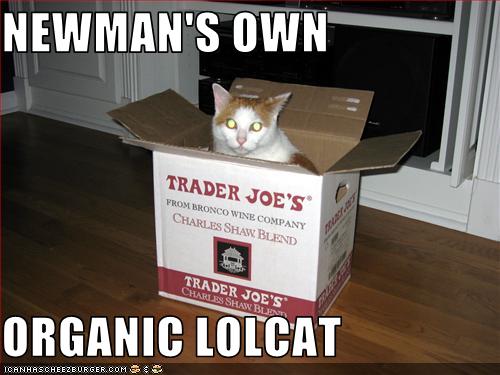
And just because no post of mine would be complete without one, here's a lolcat:


Wednesday, February 22, 2012

The MTN Saga Continues

But I'm not quite sure what to make of it.

(In last week's episode, our hero wanted to upgrade to a Galaxy Nexus on his MTN contract, but learned that it likely wouldn't be possible. MTN then firmly ignored him)

On Monday, having had enough of being ignored, I decided to embark on a Twitter mockery campaign under the #MTNGalaxyNexus tag. An example of what I posted:

After a few similar tweets, I seemed to get their attention, and they responded with:

Right. I already knew that. Doesn't give me any new information and, most importantly, makes no effort whatsoever to try and retain me as a customer.

But then something happened that I didn't expect: they responded on Hellopeter too (emphasis mine):


Kindly note that the Samsung Galaxy Nexus has been fore casted for Quarter 2 of 2012. However, we can only advise from April 2012, when the handset will be available for sale from MTN.
We would like to thank you for your patronage and continued support as a subscriber and trust that your stay with MTN SP will be Ayoba. 
Um, wut?

I don't know what to do with this information. Mike Fairon and @MTNSouthAfrica both claim that MTN will not be selling the Galaxy Nexus. But MTN's Hellopeter person strongly suggests that it's not a matter of if but when it'll be available.

Is someone mistaken? Has their policy changed? Am I being lied to mislead to stop me from leaving?


In my state of confusion, I entertained an alternative idea: in the interests of avoiding a potentially messy porting situation, what if I just choose a different device? My current phone is as good as any in MTN's current range, but what if I get something other than a phone? What if I get a Samsung Galaxy Tab 10.1?

Nice!
So, today, while I happened to be walking past an MTN outlet, I decided to pop in and ask about that. I asked if I would need to increase my subscription fee or anything if I were to get one of these on my upgrade (which is now due tomorrow).

The answer? No.

Apparently it is physically impossible for me to take a tablet device on my current contract. The only possible way the universe will allow it to happen, is if I switch to a data-only contract. Now, I'm not a fan of talking on the phone, but it's still a necessity... a data-only contract is of no use to me. I'm not doing that.

So here I sit, still with little to no clarity on the situation, some contradictory messages from MTN and a bleak outlook for what should be a happy Upgrade Day tomorrow.


Friday, February 17, 2012

Continuing MTN Fail

I posted a few days ago about a dilemma I'm facing about my choice of cellphone, and of cellular network.

(The story so far: I want to upgrade to a Galaxy Nexus next week, but MTN South Africa has decided not to carry the device.)

Let's just take a look at the Galaxy Nexus quickly.

*sigh*

Thing is, it's not even about the phone anymore. As much as I want to have this device, I'm not an unreasonable guy. I might be open to considering alternatives.

What's seriously pushing me away right now is MTN's complete failure to engage with me about it. In addition to my last blog post (which was enough to catch their attention last time) I've also sent them three tweets. The most recent one:


There's been plenty of activity on the @MTNSouthAfrica Twitter account, so it's not as if it's down or anything... they've just decided to ignore me. I've also tagged them in a post on Google+ for what it's worth.

Now, I may not be a major corporate customer, but as individual customers go, I reckon I'm probably at least in the top 5% over there. I give them a lot (far too much, in fact) of money. I probably single-handedly pay for one of the awesome coffee machines they have over at the Innovation Centre.

They dispense liquid love
(photo courtesy Barbara Curtis)

I haven't tried calling the call centre. Last time I tried that, I was on hold for over an hour before I was cut off, and never actually got to speak to anyone. I don't have that kind of time to waste.

I was at a conference last week where Gio from Virgin Active SA was presenting. He, and others, made some very powerful points about how to keep customers happy: Can't do what I ask? Talk to me, apologise and try to make it up to me.

Continue to ignore me and I'll be gone, and not quietly. And I won't be alone. Someone else will have to pay for your coffee machine.


Tuesday, February 14, 2012

Here we are again - MTN fails once more

My dedicated reader (I assume there's only one of you who generates all my traffic) will recall an incident approximately 22 months ago when I had a bad experience trying to upgrade my phone to the HTC Desire, thanks to some ineptitude on the part of MTN.

It was frustrating and unnecessary, but it worked out okay in the end. I eventually got the phone I wanted, and began my journey as an Android user. All sins were forgiven and all was right with the world.

There's an even better sequel to the story: in July last year the Desire was stolen (booo!). Insurance replaced it with an even more awesome HTC Sensation, which I'm still rocking hard today (yay!).

Ain't she purdy?
A thought occurred to me a few days ago: odds are I'll be due for upgrade again soon. I should probably start my research.

The first step in my research was to check the date of my upgrade. Luckily MTN's (otherwise useless) MTNDirect site has a little thingy that tells you when your next upgrade is due... and I was told that mine is in two weeks!

I did a happydance.


Why was I so happy? Because this meant I got to upgrade to the Galaxy Nexus! I saw one in real life for the first time at a conference last week. It climbed in through my eyes, and made little purring noises in my heart.

It says "Prrrrrr"
I've always wanted to own a Nexus phone (Google's line of "pure" Android devices), and this is the first time I've been due for a new phone around the time a Nexus was to be released in South Africa. So I did some more Googling to find the exact release date (to see if I'd need to wait a week or two, or whatever) and to my horror, I found this.

“At this stage MTN has not enlisted the Galaxy Nexus, but as per our evaluation process, will continue to review possible enlisting – more so in 2012 with the increasing traction of Android,” said Mike Fairon, general manager for product innovation and development at MTN SA.

MTN will not be carrying the Galaxy Nexus. You know who will be carrying the Galaxy Nexus is South Africa? Every. Other. Network. Seriously. Even Virgin Mobile (do they even count as a network?) will be getting some stock in. MTN, in all their wisdom, will not.

Awesome.

So now I'm faced with a dilemma.

Having a Galaxy Nexus is about ten million times more important to me that having anything to do with MTN. The only reason I'm reluctant to move is that I've had bad experiences with that in the past, and I dread the drama that will ensue if I try to port my number to a proper, modern, forward-thinking network like Cell C.

So, Mike Fairon is clearly an incompetent fool misinformed with no sense of market direction: refusing to stock the flagship Ice Cream Sandwich phone in their range. Also, he is quite probably the devil.

Mike Fairon - probably

Oh, and to add insult to injury, I tweeted a couple of questions to @MTNsouthafrica about it, trying to get some clarity on things. Two days now and no response. Awesome customer service, guys.

So now what? I'm basically screwed. I can "upgrade" next week and get, like, a Galaxy S II... which has almost the same specs as my Sensation. Or I wait until my contract expires in a couple of months, and run the risk of falling foul (once again) of the anticompetitive (and probably illegal) number-porting policies these thugs employ.

I used to like being with MTN. I signed on with them eleven years ago because they were the forward-thinking bunch: they sold me a Nokia 6310 when Vodacom was still pretending HSCSD was lame. (It is lame by today's standards, but in 2001 it was amazeballs)

I guess that happens to large corporates: they lose focus, lose touch with the market and their customers... then they lose market share, and eventually lose their business. Probably best to jump ship now, I guess.


Monday, January 30, 2012

The 22seven Thing: A short, one-act play in lolcat

22seven: "Hay guise. We maed u a PFM tool, and we did not eated it!"

Me: "Yay1"

Banks: "Noes! 22seven is ebil! They will nom ur cookeez!"

Me: "STFU Banks! I like them because u say they're bad! Oso becos ur dumb, and they is smart."

Me & 22seven: *does happydance*


Saturday, December 31, 2011

Spam Spam Spam Spam Spam Spam...

So someone has decided to ruin it for everyone, defecating spam all over my comments boards. As a result, I'm stepping up security around here. Sorry for the inconvenience. If you find this guy, punch him in the face for me.

Monday, September 19, 2011

Sangomas In Suits

So, a few weeks ago I was given the awesome opportunity of participating in the 48 Hour Film Project with a team of amazingly talented people. The movies were premièred this past weekend, and now ours is up on YouTube for everyone to enjoy:

(don't worry, it's only 7 minutes long)


A glance at the credits will show you that I was lucky enough to be able to help out with the project in several different ways. It was enormously gratifying to be given the chance to do that, and cringingly awesome to see myself on the big screen.

Thanks to the team for including me in such a memorable experience. Thanks to Director Bianca Bothma for giving me jobs to do. And thanks in particular to the film's talented and lovely Art Director, Manders, for recruiting me.

If you enjoyed the movie, be sure to Like our Facebook page!